


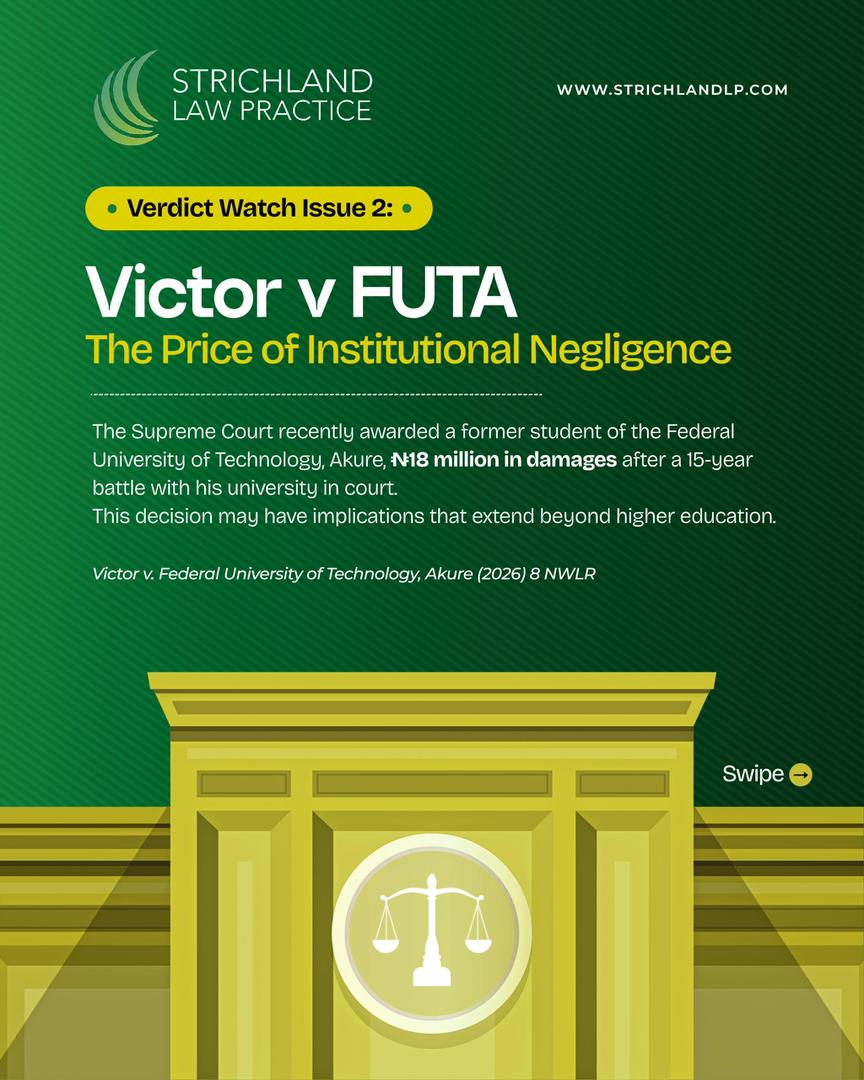
Victor v. Federal University of Technology, Akure (F.U.T.A.) (2026) 8 NWLR
Introduction
A landmark Supreme Court decision confirms that Nigerian universities owe their students a legally enforceable duty of care in academic matters — and that courts will award substantial damages where that duty is breached. The ruling also sends a clear signal on the adequacy of damages: nominal awards that ignore prolonged student suffering will be corrected on appeal.
Background: A Student’s Fifteen-Year Ordeal
The appellant studied Mechanical Engineering at the Federal University of Technology, Akure (FUTA). Upon completing his degree, he believed that the cumulative grade point average (CGPA) recorded against his name was incorrect — that errors in the marking of several courses in his second, third, and final years had caused him to be awarded a Second Class (Lower Division) degree when his true scores, properly computed, would have placed him in the Second Class (Upper Division) category.
He wrote to the university repeatedly for four years (from 2007 to 2011) asking for a remark of his scripts by independent examiners, or at least an investigation into how he came about those scores. The university did not respond. She refused to remark his papers, nor release his transcripts, and ultimately told him that she would not act on his request at all.
The practical consequences were severe for the Appellant. Without a transcript or certificate, he could not take up employment befitting his qualifications. Critically, he was unable to take up a fully-funded Nigeria Agip Exploration International Post-Graduate Scholarship Award for a one-year Master’s degree programme in the United Kingdom — a scholarship for which he had been selected, and which was valued at over £24,000 (including tuition, accommodation, and living expenses). He lost that opportunity entirely.
In August 2011, having exhausted every avenue within the university, the appellant filed a suit at the trial court. He represented himself throughout the entire hierarchy of courts — from trial in 2011 all the way to the Supreme Court in 2026. He was, in the court’s words, “a layman who appeared for himself throughout.”
Litigation Timeline
| 2007 | Appellant completes his degree at FUTA. Results not released; begins internal appeals to university. |
| 2007–2011 | Appellant writes letters and travels back and forth for four years pleading for a remark. University refuses. |
| August 2011 | Appellant files suit at the trial court seeking independent remark of scripts and release of transcripts/certificate. |
| January 2013 | Trial court strikes out claim as statute-barred. |
| November 2013 | Court of Appeal sets aside the striking-out order and remits case for trial on the merit. |
| September 2017 | Trial court delivers judgment: grants remark order; awards ₦500,000 general damages. Respondents appeal; appellant cross-appeals on damages. |
| February 2019 | Court of Appeal dismisses respondents’ appeal; allows cross-appeal in part. Awards ₦200,000 costs (cross-appeal) and ₦50,000 trial costs. Damages unchanged. |
| June 2022 | Supreme Court (SC/1022/2019) dismisses respondents’ further appeal after mediation; directs compliance with remark order. |
| November 2023 | Supreme Court orders appellant to collect his degree from FUTA. |
| 2024 | FUTA physically delivers appellant’s degree certificate and transcripts in open court. Appellant’s cross-appeal on damages proceeds. |
| 2026 | Supreme Court allows cross-appeal in part: awards ₦18,000,000 general damages and ₦2,000,000 costs. |
What the Courts Decided
The trajectory of this case through the courts reveals a frustrating but ultimately vindicated journey. The trial court, after a full hearing, found for the appellant and directed FUTA to remark the affected examination scripts using external examiners, and to issue the appellant a final result and transcript reflecting his true performance. It awarded ₦500,000 in general damages.
The respondents appealed. The Court of Appeal dismissed the university’s appeal in its entirety. The appellant however cross-appealed on grounds that the damages awarded to the tune of NGN500,000, was insufficient. The Court agreed in principle that the ₦500,000 was modest but declined to disturb it, instead awarding ₦200,000 costs for the cross-appeal and ₦50,000 trial costs. The underlying damages figure remained stubbornly at ₦500,000.
FUTA appealed again to the Supreme Court. That appeal was withdrawn and dismissed in June 2022 following mediation, with the university directed to comply with the remark order. The university eventually did so — and the appellant was upgraded to Second Class (Upper Division), vindicating everything he had been saying since 2007. In a poignant moment, FUTA physically delivered the appellant’s degree certificate and transcripts to him in open court before the Supreme Court judges.
What remained before the Supreme Court was the appellant’s cross-appeal on damages. The central question was; was ₦500,000 — awarded in 2017 for a breach of duty that had been ongoing since 2007 — adequate compensation for what the appellant had endured?
The Supreme Court’s decision in this case is significant on several levels. It brings together threads of Nigerian jurisprudence that had previously been scattered across different decisions and weaves them into a coherent doctrinal framework on universities and their students. The Court held accordingly, that:
1. Universities have broad but not unlimited autonomy
The court was emphatic that university autonomy in academic matters is real and substantial. The power to award degrees, set academic standards, grade students, and enforce academic policies is the exclusive domain of the institution. Academic judgment — grading, standards-setting, degree classification — is generally not reviewable by courts. Even a student who has passed all examinations and paid all fees is not automatically entitled to a degree if the institution has legitimate grounds to withhold it (such as academic dishonesty or misconduct).
On University Autonomy, the Court held that:
“There is no doubt that the 1st respondent has the unlimited and unquestionable right like God to award certificates and degrees to its students under its enabling statutes… the absolute discretion of the University to award its degree and certificates consequent on a student fulfilling all conditions precedent cannot be queried or interfered with by the courts.”
However — and this is the critical qualification — that autonomy does not extend to arbitrariness, incompetence, or the deliberate disregard of a student’s legitimate rights. The court quoted with approval its earlier decision in Unilorin v. Rasheedat Adesina (2014), where it had made clear that where a university is adamant in neither releasing a student’s result nor giving good and verifiable reasons for withholding it, the student is entitled to court redress. Award of degrees should be done in accordance with the law and international best practice, not on the whims and caprices of university personnel.
2. Nigerian Universities Owe Students a Legally Enforceable Duty of Care in Tort
This is perhaps the most significant doctrinal contribution of the judgment. The court articulated — in more explicit terms than any previous Nigerian decision — that universities owe their students a duty of care in tort, not merely a contractual or administrative obligation. That duty encompasses three dimensions:
Academic: Competent teaching; fair and transparent assessment systems; accurate academic information; unbiased grading; due process in academic misconduct.
Administrative / Procedural: Timely processing of student records, appeals, and complaints; consistent and accessible academic policies applied fairly to all.
Pastoral / Welfare: Considering the welfare impact of academic decisions; providing access to support services; protecting students from foreseeable harm including stress and discrimination.
The court surveyed comparable developments in the UK, Australia, and other common law countries, noting that the global trend is toward recognising this duty of care in both academic and pastoral matters. Nigerian jurisprudence, the court said, has increasingly moved in the same direction, even if previous decisions had not expressly labelled it as a tortious duty.
ON THE SCOPE OF THE DUTY, the Court held:
“The duty of care of a university authority to its students over their academic studies refers to the legal and ethical responsibility the university owes to ensure that students are treated fairly, supported appropriately, and not subjected to foreseeable harm including academic, psychological, or procedural harm during their studies.”
3. The Damages to the tune of ₦500,000 was ridiculously low
The court’s treatment of damages is refreshingly direct. By the time the ₦500,000 award was made in September 2017, the appellant had already been suffering the consequences of the university’s breach for ten years. He had lost his scholarship. He had been unable to work in his field. He had spent years and significant personal resources navigating the court system alone, as a layman. The court described the ₦500,000 award as “too small in the circumstances” and noted that the actions of the respondents amounted to “a wholly cynical and deliberate disregard for the right of the appellant.”
Okoro JSC, in a concurring judgment, called the ₦500,000 “paltry.” Ogbuinya JSC went further, describing it as “a pessimi exempli of a peanut within the landscape of Nigeria’s wobbling and bleeding economy” — a sum so inadequate as to constitute a circumstance deserving appellate intervention. The court referenced the well-known principle that an appellate court will interfere with a damages award where it is so ridiculously low that it must represent a wholly erroneous estimate. This, the court held, was precisely such a case.
The Supreme Court awarded ₦18,000,000 in general damages and ₦2,000,000 in costs — a combined sum of ₦20,000,000, representing a forty-fold increase over what the trial court had awarded. Comparable awards in similar cases were referenced: in University of Port Harcourt v. Nwuzor (2024), the Supreme Court had affirmed a ₦25,000,000 exemplary damages award for certificate-withholding; in Mautech v. Yarai (2020), ₦5,000,000 was awarded for wrongful expulsion. The court was aligning this case with this trajectory.
Conclusion
This decision will be remembered as the case that forced a reckoning. For too long, Nigerian universities have operated as if their internal academic processes were beyond judicial scrutiny — as if once a dispute entered the walls of a faculty board or senate, it ceased to be the law’s concern. This judgment, delivered by a unanimous five-justice panel of the Supreme Court, firmly rejects that view.
The conceptual framework the court has now articulated is an important development. It means that universities can no longer simply ignore a student’s complaint about grades or transcripts, citing institutional autonomy. Where a student raises a credible concern about the accuracy of their scores and asks for an independent review, the university has a legal obligation to respond with fairness and transparency. Silence or bureaucratic delay will now attract tort liability.
The damages award of ₦18,000,000 also deserves careful attention. It is not, as the court was at pains to stress, a windfall. It represents, in the court’s assessment, a reasonable person’s view of adequate compensation for fifteen years of suffering: loss of employment opportunities, loss of a life-changing international scholarship, emotional distress, repeated travel and correspondence costs, and the indignity of having to drag one’s own university through multiple levels of court just to receive the transcript one earned. When viewed in that light, it is difficult to argue that the award is excessive.
The case also offers a timely reminder about the state of damages awards in Nigeria more broadly. Ogbuinya JSC’s pointed observation about Nigeria’s economic conditions — inflation, the weakness of the naira — speaks to a broader judicial recognition that damages must be assessed in real terms, not nominal ones. A sum that might have been adequate compensation in 2005 may be entirely insufficient in 2026. Courts must account for this in making and reviewing awards.
Finally, the human dimension of this case should not be lost. The appellant was not a corporation or a powerful institution. He was a young engineering graduate who believed he had been treated unfairly by his university, and who spent the better part of two decades — from his graduation in 2007 to the final resolution in 2026 — fighting to prove it. He did so entirely without legal representation. The Supreme Court’s decision vindicates not just his legal claims, but his persistence.
This commentary is published by Strichland Law Practice for informational and thought leadership purposes only. It does not constitute legal advice. Readers with specific legal questions arising from any of the issues discussed may contact us on 09017291907 or hello@strichlandlp.com.
